
The field of power electronics serves as the invisible backbone of our modern world. From the silent operation of electric vehicle drivetrains to the sophisticated management of renewable energy on the national grid, the ability to convert and control electrical power efficiently is a cornerstone of 21st-century engineering. For educational institutions, bridging the gap between theoretical semiconductor physics and practical application requires a thoughtfully equipped environment.
When setting up a laboratory dedicated to this discipline, the focus must remain on precision, safety, and versatility. Here is a comprehensive guide to the essential [Power Electronics Laboratory Equipment] every engineering department should prioritize to foster the next generation of innovators.
1. Digital Storage Oscilloscopes (DSO) with Isolated Channels
In power electronics, we often deal with high-frequency switching and floating potentials. A standard oscilloscope can be a limitation, or even a safety hazard, if not used with expensive differential probes. High-quality DSOs designed for power applications—ideally those featuring isolated channels—allow students to measure gate-drive signals and high-voltage drain-source waveforms simultaneously without the risk of short circuits. These instruments are vital for visualizing the “ringing” in MOSFETs or the rise and fall times that dictate switching losses.
2. Programmable DC Power Supplies
Accuracy begins at the source. A reliable lab requires high-precision, programmable DC power supplies that can simulate various input conditions. Whether testing a buck converter or a complex three-phase inverter, the ability to set strict current limits protects both the equipment and the student’s prototype. Modern units often include logging features, allowing students to track how a circuit performs over time under varying load conditions.
3. Power Electronics Training Modules
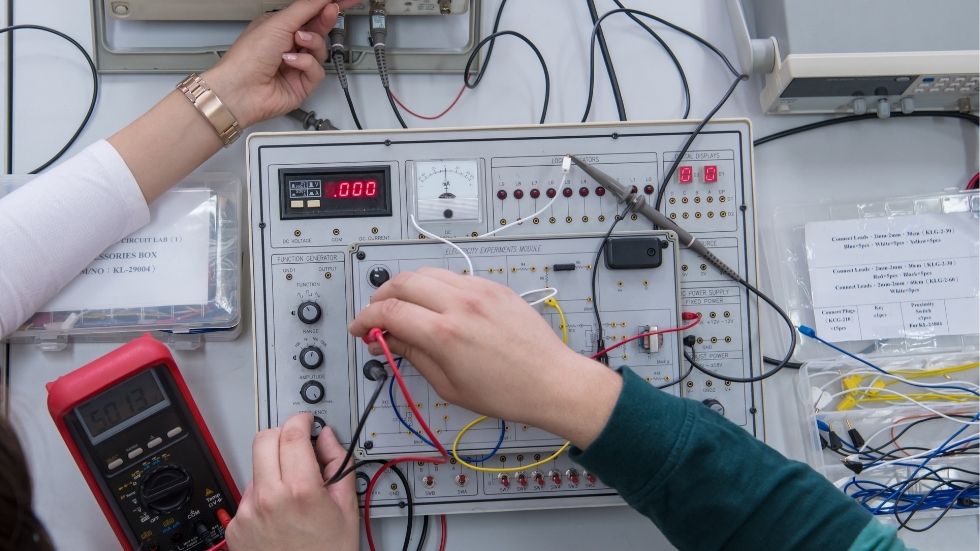
While building circuits on breadboards is fundamental for low-power electronics, power circuits involve thermal management and high currents that breadboards cannot handle. Integrated training modules provide a structured environment where students can explore different topologies—such as AC-to-DC rectifiers, DC-to-DC converters, and DC-to-AC inverters—using industrial-grade components. These modules often come with built-in protection circuits, making them a safe yet “real-world” starting point for undergraduates.
4. Digital Signal Controllers (DSCs) and FPGA Boards
The “intelligence” of a power converter lies in its control algorithm. Every modern lab needs a suite of microcontrollers or FPGAs (Field Programmable Gate Arrays) capable of generating high-resolution Pulse Width Modulation (PWM) signals. Platforms that integrate easily with simulation software allow students to move seamlessly from a virtual model to a physical hardware-in-the-loop (HIL) setup, reinforcing the relationship between code and current.
5. Variable Electronic Loads
To truly understand efficiency and regulation, a circuit must be tested under stress. Variable electronic loads allow students to simulate different types of “real” consumers—such as a constant current motor or a constant resistance heating element. Unlike traditional rheostats, electronic loads are precise, programmable, and capable of dynamic load switching, which is essential for testing the transient response of power supplies.
6. Power Analyzers
In an era where “Green Energy” is the primary focus, measuring total harmonic distortion (THD) and power factor is no longer optional. A high-precision power analyzer provides insights that a standard multimeter cannot. It allows students to quantify the efficiency of their designs and understand the impact of non-linear loads on the electrical grid, aligning their academic work with industrial standards for energy efficiency.
7. Thermal Imaging Tools and Heat Sinking
Power electronics is as much about managing heat as it is about managing electricity. Inexpensive thermal cameras or infrared thermometers are indispensable for identifying “hot spots” on a PCB. Teaching students to analyze thermal dissipation ensures they understand why component selection and physical layout are just as important as the circuit schematic itself.
8. LCR Meters and Specialized Probes
At high switching frequencies, the parasitic inductance of a wire or the equivalent series resistance (ESR) of a capacitor can change everything. High-quality LCR meters help students characterize their passive components before assembly. Furthermore, current probes (specifically Hall-effect or Rogowski coils) are essential for observing current waveforms in real-time without breaking the circuit.
Creating a Culture of Discovery
Equipping a lab is about more than just purchasing hardware; it is about creating a space where curiosity meets capability. When students have access to professional-grade tools, the friction between an idea and a working prototype disappears. They stop worrying about whether the equipment is lying to them and start focusing on why their circuit behaves the way it does.
At Indosaw, the philosophy centers on providing robust, high-quality educational tools that mirror the complexities of the industry. By investing in the right [Power Electronics Laboratory Equipment], institutions ensure that their graduates are not just familiar with the math behind the power, but are ready to master the hardware that moves the world.
Conclusion
The transition toward electrification—be it in transportation, industrial automation, or renewable energy—shows no signs of slowing down. A well-equipped Power Electronics Laboratory is the ultimate theater for learning this vital craft. By combining foundational measurement tools with modern control platforms and specialized training modules, we can provide students with the clarity and confidence they need to solve the energy challenges of tomorrow.

 – Products